

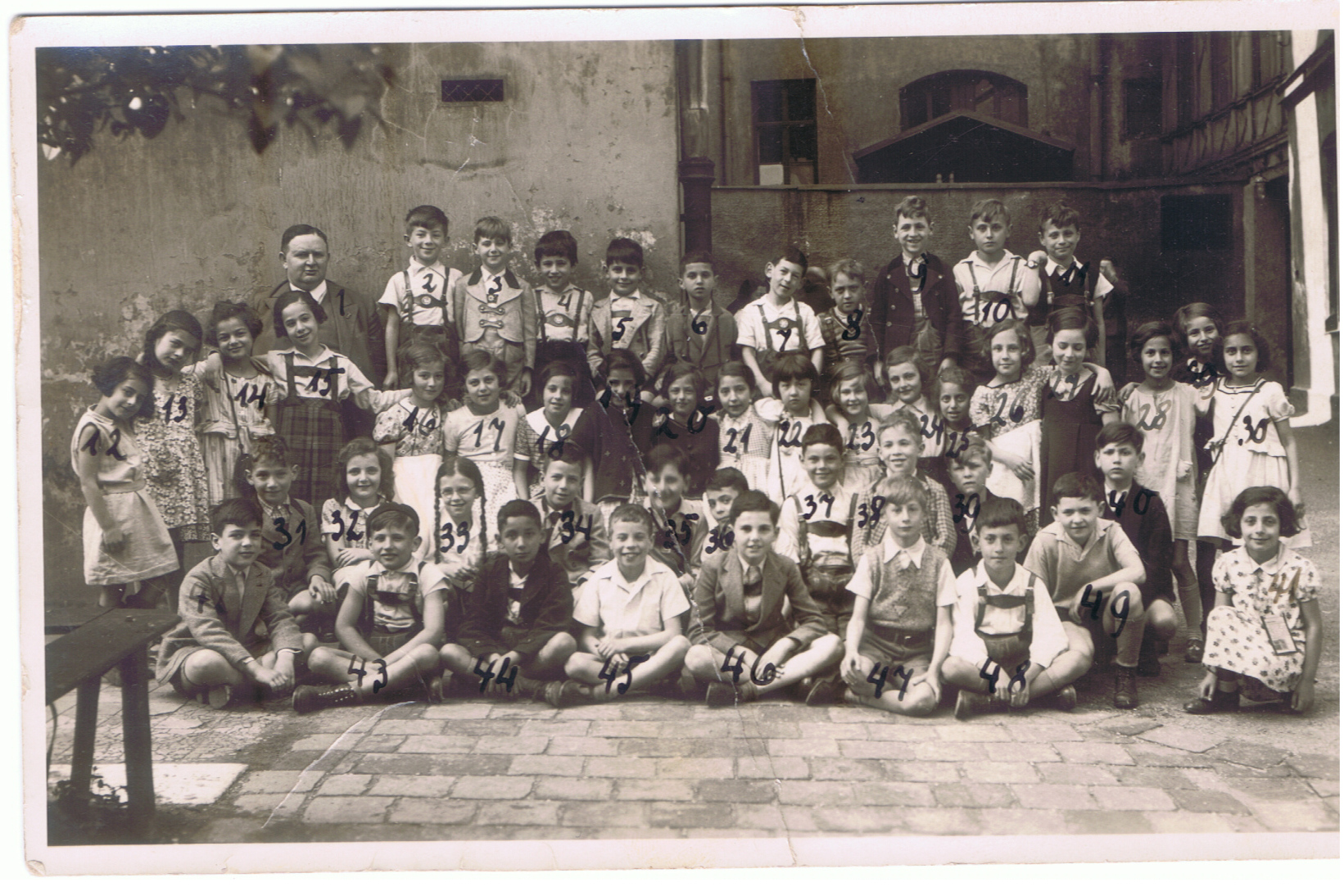
The question “What is memory?“—in art, in things and objects, in a post-migration society, during times of war and a political shift to the right—is a topic that nsdoku is continuing to address this year. The primary focus in 2026 will be on the perspectives of the children and their families who experienced Nazism and the Holocaust first-hand. At the same time, we will examine how such experiences are communicated, how memories, trauma, and conflicts are passed down through generations and which effects are still visible today. One focus of this year’s program will be local stories and biographies, exemplified by a class photo from 1937 that has provided the starting point for research and a presentation. Another will be the global issues of war, loss, and displacement, which will be explored in an international context and through artistic positions.
Questions concerning the causes of political and social radicalization and the loss of the democratic center will also be continuing themes, especially the role increasingly played by economic factors. What will happen as art and culture and history education come to depend on ever more limited budgets? What about the dramatic influence of non-state actors such as tech billionaires? How is opinion formed by capital and what happens when culture, including remembrance culture, is determined by money and power?
Exhibitons
Memory is …
Intervention featuring objects and the stories behind them | until May 10, 2026
A hat, a wooden crate, a tablet tube, a beer mug. What memories are associated with these things, what stories do they tell? What do we wish to learn from them? For one year, a series of selected objects will feature In our main exhibition Munich and National Socialism, expanding its narrative with new stories. Large and small, everyday and more unusual things allow us to access history through our senses and to view the past from a different perspective. A personal audio commentary accompanies each object, providing background and enabling us to grasp the broader context. The commentaries were written and spoken by contemporary witnesses, activists, artists, scholars, and others, including Edmund de Waal, Hamado Dipama, Lena Gorelik, Ernst Grube, Olga Mannheimer, and the initiative München OEZ erinnern!.
… to leave a space in which the din of war might die down
Exhibition of contemporary art | until July 12, 2026
The exhibition brings together contemporary art works that reflect on the lasting repercussions of war in Europe and beyond since 1945. The title alludes to Marguerite Duras’ Wartime Notebooks and references a critical process of mourning that embraces both the personal and collective dimensions of traumatic experiences. The exhibition asks how historical violence continues to resonate and explores the potential of intergenerational and transnational dialogue for a pluralist remembrance that offers orientation for the future.
Artists: Chantal Akerman, Nikita Kadan, Jean Katambayi Mukendi, Tarik Kiswanson, Hiwa K, Atalya Laufer, Selma Selman, Hito Steyerl, Sung Tieu, Miloš Trakilović, Ian Waelder, Leyla Yenirce
The Class Photo (working title)
October 21, 2026 to June 6, 2027
Forty-eight third-graders at the Jewish elementary school in Munich have assembled in the schoolyard for a class photo—a snapshot from the summer of 1937. This is the last picture on which the children appeared together. The photo provides the starting point for an intensive search to find out what happened to them. The exhibition traces the children’s life paths. It investigates their strategies for survival, the routes by which they fled, their experiences of alienation and loss, and their arrival in a new place. It uses blank spaces to visualize the absence of those who became victims of the Nazis’ annihilation policies. This paves the way for more general questions: What does it mean to be a child in times of inhumanity? How do the loss of home and forced migration shape children? And what longer-term effects do these experiences have on their families? The exhibition is based on an idea and research by the historians Kristina Milz and Julia Schneidawind. Their work is scheduled to be published as a book by C.H. Beck Verlag in fall 2026.
Educational and events program
When nsdoku reopened in May 2025, a number of new educational formats were launched, including our Erinnerungssprechstunde (Memory Surgery), which invites visitors to reflect on the future of remembrance in an open forum and to discuss this with others. We have also developed new programs for elementary school children which have in the meantime become established workshops for school classes. In Deine Stimme zählt! (Your voice counts!) children learn more about democracy and their basic rights and are encouraged to stand up for these and express their opinions.
Our Spring School, to be held in March 2026 and based on the exhibition … to leave a space in which the din of war might die down, will be devoted to the impact of violent conflicts worldwide, both locally and in German society and what kinds of challenges these pose. The feeling of insecurity in the face of global political conflicts and interpersonal challenges is palpable in schools, other educational institutions, and companies and has led to an increasing demand for historical-political educational work. There is a particular demand for formats offering prevention and active support in a time that is perceived in many places as insecure and threatening. With a focus on current problematic areas and developments our educational and outreach program addresses issues such as propaganda and disinformation, exclusion mechanisms, antisemitism and racism, and forms of linguistic radicalization.
nsdoku cooperates with many Munich institutions and people, including the Kammerspiele theater, the Literaturhaus, and America House, to mention just a few. We will be present at various festivals again in 2026; in May, for example, we will show a new documentary film program at DOK.fest München. We will also join forces with the GoDrag munich Festival to address politically motivated hostility to trans people. Among the most topical subjects in our program of events is the issue of how artificial intelligence and cyber-fascism are changing art and culture. Currently, we are seeking to recruit freelance guides. The aim of this campaign is to expand and diversify our approach to topics such as criticism of racism and antisemitism, hostility to LGBTIQ, and remembrance culture in a diverse society.
Publications and Research
While continuing to publish exciting articles about art, culture, society, and politics in our online magazine, we are also planning some new publications for 2026. These will be available in our new shop in the refurbished nsdoku building. Taking as a starting point the graphic novel about the contemporary witness Ernst Grube Zeit heilt keine Wunden (Time Does Not Heal Wounds), published in 2024, nsdoku will present jointly with the Bayerische Landeszentrale für politische Bildungsarbeit (Bavarian Agency for Civic Education), in early 2026, a manual to assist teachers wishing to use graphic novels in education. In addition, the Landeszentrale will include Zeit heilt keine Wunden in its list of publications, making it available to both pupils and teachers for a reduced price.
Alongside the research cooperation with the Stadtsparkasse München bank, which in 2026 will continue its historical appraisal of the former "Städtische Sparkasse München" during the Nazi era from 1933 to 1945, we are also conducting a new research project called Kunst und die völkische Bewegung (working title), which began in 2025. In cooperation with the Lenbachhaus art gallery, it is studying the connections between the nationalist (völkisch) movement and artistic personalities in Munich around 1900. On July 30, 2026, we will be holding an interdisciplinary symposium on the topics covered by the research project. Subsequently, the participants' contributions will be published in a collective volume.
We plan to make our online lexicon available in English in 2026. Comprising more than 900 entries, our lexicon contains detailed information on a variety of topics, events, organizations, places, and people of relevance to Munich’s Nazi past that are also dealt with in the exhibition Munich and National Socialism.
nsdoku Neuaubing
A branch of the Documentation Center is being created on the site of the former forced labor camp at Ehrenbürgstraße in Neuaubing. Through an interaction between history education, art, social facilities, and artisanship the aim is to make the former forced labor camp a place of living remembrance that invites visitors to reflect on the history of Nazi forced labor and its connections with the present. Two of the historical barracks are currently being converted to create spaces for exhibitions and for education and events. The script for both the analogue and the digital exhibition has now been finalized, and the exhibition design is making good progress. In addition, educational and event formats are being planned that will address the main topics and will be able to be implemented even before the Neuaubing site opens. The opening is planned for 2027; however, the basis for full operation of the site—currently without additional staff posts—is still uncertain.